Pharmaceutical industry: what tests are used to ensure packaging is leak-proof?

In the food industry, faulty packaging (more often than not) means a wasted product. But in the pharmaceutical industry, it means a life potentially at risk… This fundamental difference explains why the requirements for pharmaceutical leak testing are on a completely different level in terms of precision and reliability.

It is against this backdrop that Control Sensei and DVACI are working to improve a benchmark method for pharmaceutical packaging integrity: the methylene blue test.
Our aim: to increase efficiency without compromising on rigour. A brief summary of this well-known test, and a presentation of our innovative approach.

From blister packs to injectables: the challenges of pharmaceutical packaging

Medicines packaged in blister packs, vials or pre-filled syringes (PFS) share a common requirement: their packaging must be completely leak-proof (obviously!). However, each format presents its own challenges during inspection.

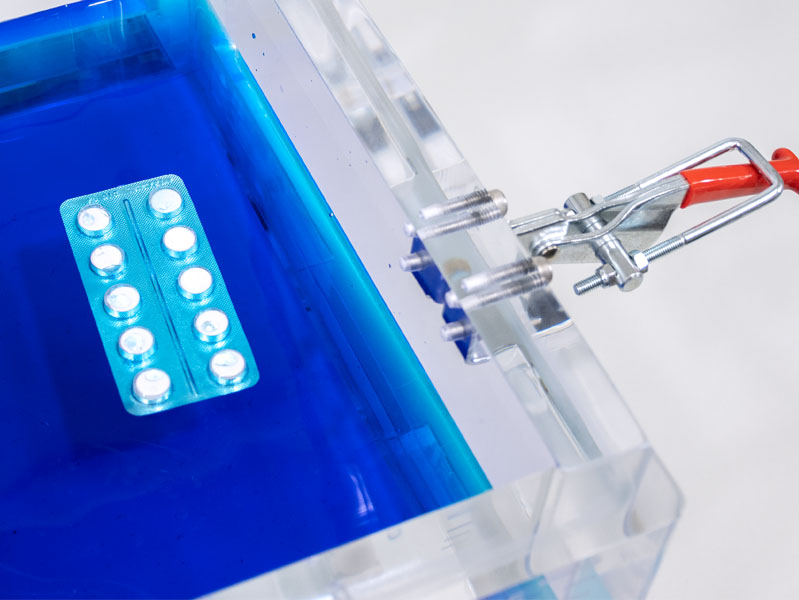
For blister packs, what makes testing difficult is that the limited volume, depending on the size of the leak, will result in a tiny amount of very small bubbles that are difficult to detect. The dye penetration test is therefore preferred.

For tinted bottles, designed to protect active ingredients from light, the difficulty lies precisely in the colour: the colour of the container itself can mask the presence of methylene blue inside, even in the event of a confirmed leak.

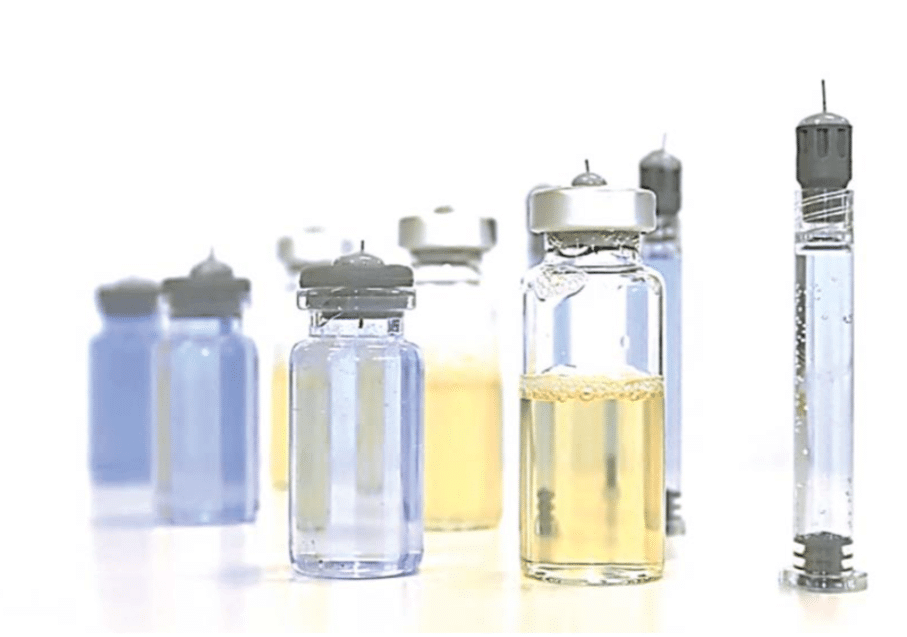
The CCIT (Container Closure Integrity Testing) protocol in the pharmaceutical sector applies in particular to containers such as ampoules, vials, flasks and PFS.
And unlike in the food industry, where the aim is to detect leaks of around 80 to 100 microns, the thresholds in the pharmaceutical sector are as low as 30, or even 10 microns.
Furthermore, to achieve absolute sterility, it is necessary to go even further (below the micron level), using technologies such as helium tracer gas or High Voltage Leak Detection (HVLD).

The methylene blue test as part of the CCIT

Choosing the right method based on the detection limit

As you know, the CCIT is not a method in itself, but a regulatory framework that requires all manufacturers to demonstrate the integrity of their packaging, from production right through to the patient.
[For a complete overview of the available methods, visit our page dedicated to CCIT testing.]

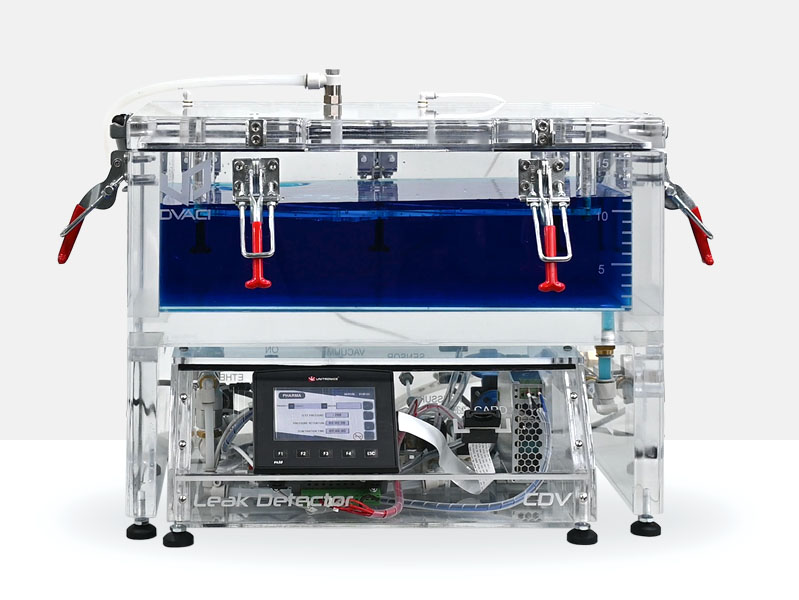
For leaks between 30 and 50 microns, testing by immersion in a methylene blue solution is a recognised and widely used method. This is precisely what Control Sensei offers with its specialised vacuum chambers for blister packs and pharmaceutical packaging.

The penetration phase: the most critical

A quick reminder of the test cycle:
1. Vacuum to −270 mbar
2. Maintaining the vacuum for 10 minutes (ISO 8871-5-2016 Annex D) and immersion
3. Return to atmospheric pressure (with a 30-minute wait this time…)

It is this return to atmospheric pressure after the vacuum phase that allows the dye to penetrate any leaks via pressure differential. And it is this penetration phase that is the crux of the matter and the focus of our considerations, because it is the longest, and the one most likely to be overlooked in practice.

Yet it is this phase that determines the reliability of the result.

A complete cycle for this test therefore lasts around 45 minutes, which means running three machines (across three stations) in parallel and continuously to test a production run every 15 minutes.

Another limitation to bear in mind is that of visual detection.
At a concentration of 1 g/L, the dye is certainly highly coloured, but the volume passing through a 40-micron leak remains minuscule!
So yes, on a solid (pill, tablet), the colouration is easily spotted. But on a clear liquid, a very trained eye is required, or a photometer must be used to estimate the methylene blue contamination.

The innovative DVACI and Control Sensei approach: reducing test time without compromising on quality

It was through regular work in the laboratory, in collaboration with our industry partners, and by gaining a thorough understanding of how pressure affects different types of packaging, that the idea emerged: to introduce a slight positive overpressure after the pressure has returned to atmospheric levels, in order to actively ‘push’ the dye towards the leak rather than waiting for it to reach it naturally.

The optimised cycle of the DVACI Pharma V&P device is therefore as follows:

  1. Vacuum to −270 mbar
  2. Maintenance of the vacuum for 10 minutes (in accordance with ISO 8871-5-2016 Annex D) and immersion
  3. Return to atmospheric pressure
  4. Positive pressurisation, which triggers the penetration phase and directs the dye more rapidly towards the leak
  5. Return to atmospheric pressure and visual inspection or photometer reading.

Our tests are highly conclusive: by shortening the duration of the penetration phase, this approach improves the throughput (and readability) of the tests, and reduces the number of devices required without deviating from current standards.

Conclusion

The methylene blue test has proven its worth in the pharmaceutical industry for decades. However, the time required for the procedure creates risks of oversight or difficulties in testing large volumes.
What we are exploring with DVACI is the next evolution of this essential test: faster, more logistically flexible, and just as rigorous.

Would you like to assess whether this approach is suitable for your containers and production rates? Get in touch: we’ll analyse your requirements and guide you towards the most appropriate solution.