



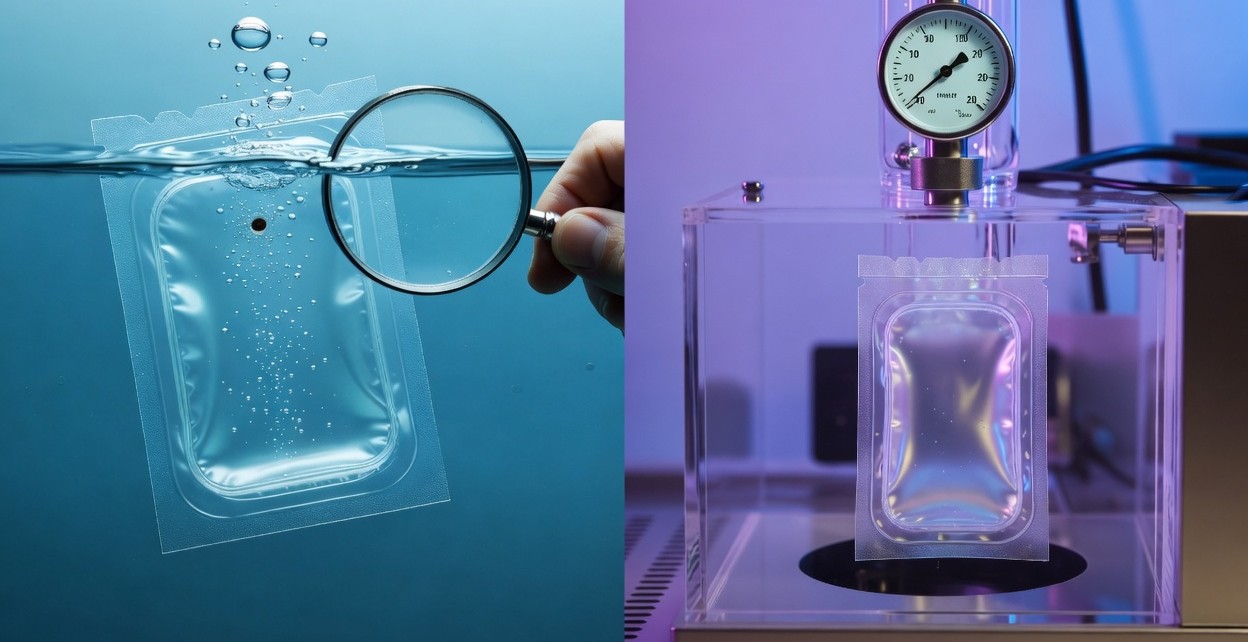
Leak testing is an essential step in the pharmaceutical industry. And in this sector in particular, product integrity is paramount, as it directly affects patients’ health and safety.
In the face of new requirements and innovations in testing, traditional methods sometimes reach their limits.
Whilst the ‘bubble test’ remains essential in many situations, the ‘vacuum decay’ test is likely to become increasingly prevalent within major pharmaceutical groups for testing flexible and/or rigid packaging.
So, should you continue to look for bubbles or switch to vacuum measurement for your packaging? The challenge is to clarify the physical difference between these two approaches so that we can advise you best according to your products and your specific needs.
The ‘bubble test’: a classic… but one that has its limitations
The principle of visual bubble detection by immersion is a classic in the industry. Its main advantage is its ability to pinpoint the exact location of the defect. It is a foolproof visual method for identifying the position of a leak.
However… This method relies on the operator’s sharp eyes during long (or slow…) tests, which pushes the test to the limits of human capability. When leaks are very small, the frequency of bubble appearance slows down, sometimes to just one bubble every 10 minutes!
Another major drawback: it is very difficult to reliably detect a leak smaller than 30 to 50 microns in water, which the gas must push through and around in order to form a bubble and escape. Below this threshold, there may be a leak, but no bubble.
Finally, you know me – there’s inevitably a business and CSR issue: the waste associated with the destructive nature of the test. Because submerging a product in water effectively damages the packaging. Worse still, if a leak is confirmed, the return to atmospheric pressure will allow water to enter, along with all the pathogens it carries.
Vacuum decay: technology that boosts ROI
The vacuum drop test is a game-changer: rather than looking for a bubble, we try to induce a leak and measure the drop in pressure.
Here’s a bit more physics: as air is very low in density and has low viscosity (unlike water), it flows easily, even through leaks measuring just a few microns.
The main advantage of this technology is that it is non-destructive. A flexible product can be tested without coming into contact with water (and without causing it to burst).
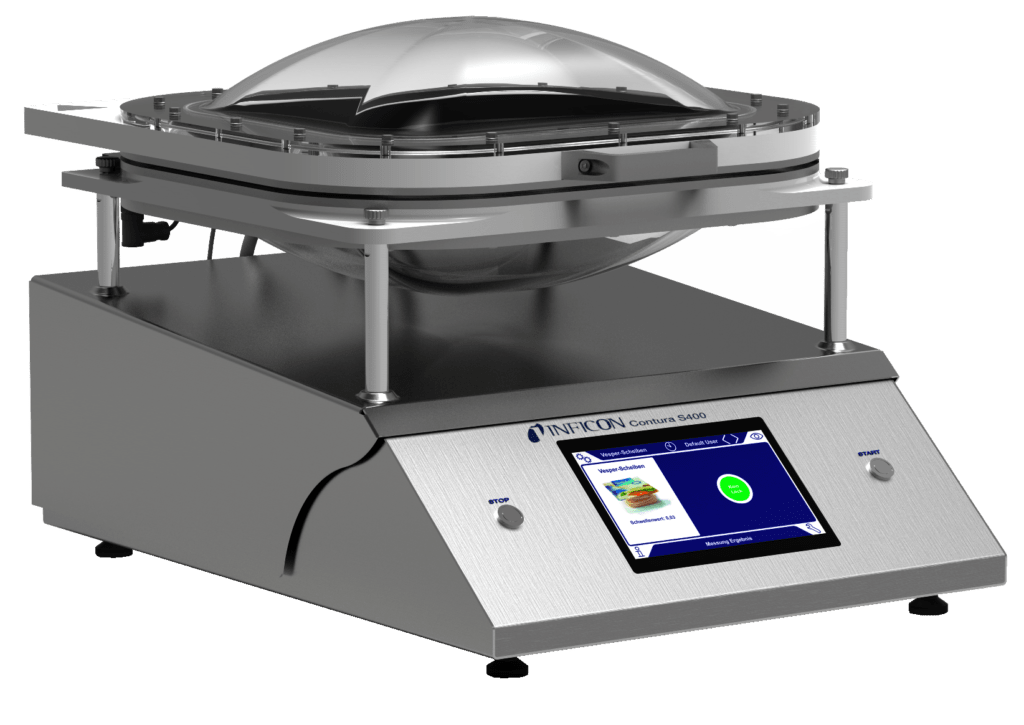
Another advantage is that the test is much faster. It takes around 15 seconds in a machine such as Inficon’s Contura, compared to a minimum of 1 to 2 minutes in a conventional vacuum chamber. And it is also binary, so there is no room for doubt regarding the results.
These logistical, CSR and financial benefits enable some manufacturers to test up to 100% of their production.
Case study: why Grifols took the plunge
For this Spanish pharmaceutical company, the challenge was to carry out an integrity test on the secondary packaging of sterile infusion bags (a critical element protecting the bag from the external environment).
The objective: to detect leaks of up to 10 microns.
The solution proposed (and retained): the installation of a Contura machine, from Inficon.
The maximum tolerated leakage rate was set on the Contura to 0.01 mbar. L/s (corresponding to 10 microns). The result, indicated by visual LEDs, becomes binary and probably possible for the operator:
- Flow rate calculated≥ 0.01 mbar. L/s → Leak → Red LED
- Flow rate calculated< 0.01 mbar. L/s→ No leakage or leakage below a flow rate of 0.01 mbar. L/s (diameter less than 10 microns) → green LED
Simple and effective.

That said, far be it from me to disparage the bubble test, which remains a mainstay of the industry and can be used alongside vacuum decay testing to locate a leak (from 30 microns upwards, as you’ll have gathered!).
And in terms of budget, the cost of vacuum decay testing equipment is rather high. Inficon’s Contura is the only device on the market to offer the use of flexible membranes that adapt to a variety of packaging types (small, large, flexible, rigid, etc.). Without Inficon’s innovative flexible membranes, costs mount up quickly, as a specific tool is required for each type of packaging tested.
In summary
The bubble test has proven its worth and remains essential for the visual detection of defects, but it has its limitations when it comes to meeting productivity targets and reducing waste. Faster and non-destructive, vacuum decay testing is becoming the standard for ensuring flawless product integrity, particularly in the pharmaceutical industry, and I am delighted with my partnership with Inficon, which enables me to offer you stand-alone tests in our laboratory, or a Contura installation in your own laboratories.
Would you like to assess the ROI of switching to this non-destructive testing method?